


 Comentar
 -
- +
+


Translated: Angela Buxton


Mirror
(Jaume Roig - Raimon)
probably in València
at the beginning of the fifteenth
century. It's known for sure
that he died on a Saturday
the fourth day of the month of April,
in the year fourteen seventy-
eight, in this city.
He studied "Medicine
and Arts" in the city of Lleida
at the university
and at the Sorbonne, Paris.
He was famous as a doctor,
an examiner of doctors
and Councillor of València.
He's gone down in history
as the author of a novel
which he entitled Mirror
written entirely in verse.
Mirror is an important work,
of obvious misogyny,
more quoted than read,
of over sixteen thousand verses
of which I'll relate to you
ninety-seven. Those needed
to tell you a story
both terrible and horrifying,
of a restaurant in Paris
where human flesh was served,
well cooked, according to the author:
Moreover, that year,
in the new world,
something strange
took place
on New Year's Day.
Being the marshal knight of the joust,
I invited
all of the knights
who had jousted there
to have supper
and a good time.
There we had
all sorts of dishes;
of wild animal meat,
poultry,
the most wonderful
pastries,
the most famous
of all Paris.
In one pie,
chopped up, ground,
the tip of a man's finger
was found.
The one who knew him
was very upset;
he realised
he would find in it
more things; there was
a piece of an ear.
We thought it was beef
that we were eating,
until we found
the nail and a piece
of a finger half cut up.
We all looked,
and decided
it was really human flesh.
The pastry cook,
with two helpers,
her grown-up daughters,
was both baker
and tavern-keeper;
of the ones who came
there to drink
they killed some;
of the chopped up flesh
they made pies,
and of the bowels
they made sausages
or salami, that were
the finest in the world.
The mother and the girls
sold as many
as ever they made,
and if there weren't enough
they killed
a few cattle:
and they covered
all their meat
with the finest sauces
which they would taste.
These false women
in a soft pit,
as deep as a well,
removed flesh from bones,
legs and torsos,
and put them in there;
and so they filled it
the daring females,
cruel and depraved,
pagan, wicked
and wretched,
abominable!
Certainly, the demons,
as they killed them,
helped them, I think,
as did the devil.
I bear witness
that I ate quite enough:
never meat nor broth,
partridges, chickens,
nor francolins
of such taste,
tenderness, sweetness
I've ever eaten.
But in the morning,
all three of them
they cut into quarters;
and their inn
they pulled down
and flattened,
they scattered salt there;
and all the bodies,
cut up in pieces,
(they counted a hundred)
they buried
in sacred ground.
(2000)
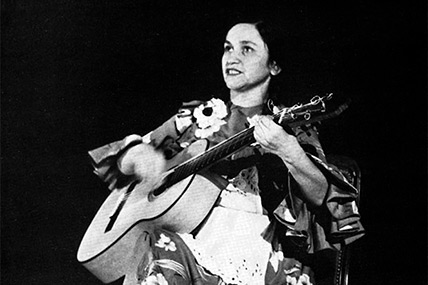
El Cancionero y Discografía de Violeta Parra, impulsado por cancioneros.com, continúa siendo una de las investigaciones documentales más importantes dedicadas a la universal artista chilena. Cuatro años de investigación permitieron recuperar 520 canciones, reconstruir su discografía, corregir numerosos errores históricos y fijar datos fundamentales sobre una de las figuras esenciales de la música latinoamericana.
El Cancionero y Discografía de Violeta Parra, impulsado por cancioneros.com, continúa siendo una de las investigaciones documentales más importantes dedicadas a la universal artista chilena. Cuatro años de investigación permitieron recuperar 520 canciones, reconstruir su discografía, corregir numerosos errores históricos y fijar datos fundamentales sobre una de las figuras esenciales de la música latinoamericana.
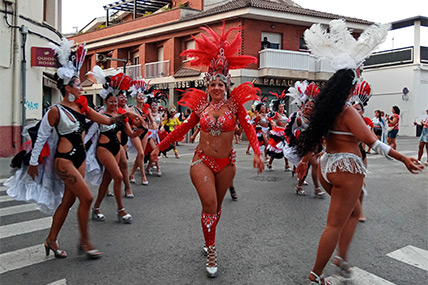
El pasado 18 de julio de 2026 se reunieron 11 comparsas de todo el territorio español en la pequeña localidad de Palau-Solità i Plegamans, a 25 km de Barcelona. Una concentración carnavalera uruguaya que finalizó con un concierto de todo un referente de este género musical afrouruguayo, Eduardo Da Luz.
El pasado 18 de julio de 2026 se reunieron 11 comparsas de todo el territorio español en la pequeña localidad de Palau-Solità i Plegamans, a 25 km de Barcelona. Una concentración carnavalera uruguaya que finalizó con un concierto de todo un referente de este género musical afrouruguayo, Eduardo Da Luz.
© 2026 CANCIONEROS.COM
Notas legales
Servicios
• Contacto
• Cómo colaborar
• Criterios
• Estadísticas
• Publicidad
Síguenos


